Friday, January 31, 2014

Deeply Irrigating in Response to Drought Emergency -- am I mad or glad?

Our Governor recently declared the State of California to be in a "Drought State of Emergency". So yesterday, I gave begarden's becoming-drought-adapted home garden a good soaking. 

Does that sound like a bad thing to do in light of the drought emergency? Actually, no. It is a good thing to do. If you haven't watered your drought-adapted garden lately and you are in Southern California, do it this weekend, and not when weather is warm. Just be sure the air temperature is above 40F when you water. Morning is best. Also, better when air is still.

Yesterday, with lower temperatures, cloud cover, and slightly more humid air, evapotranspiration rate (rate of the combination of evaporation and plant up-take of water) was relatively low. That means, gravity will naturally pull more irrigation water deeply into the soil, because not so much will be "lost" to evaporation. Trees and shrubs will take up what they need, leaving the rest for later and for others. This way, we are also recharging local groundwater, which in part helps support the root system of large, local trees we rely on for summer shade in our hot climate. In general, shrubs and trees will extend their roots more deeply with deep, infrequent irrigation, helping them through periods of drought.


The intent of seasonal, deep and infrequent irrigation is to replicate what nature provides during winter in a theoretically "average" year. Actually, we rarely if ever get an "average" year's rainfall in Southern California. Our average is an average of wetter years and drier years. We tend to have one or the other extreme, sometimes for years at a time. That is why our locally native plants, and secondly, those of similar climates are most well-adapted to this pattern.

If you work on getting your plants well-hydrated and ready for summer now, you can relax in summer while they assume whatever is their drought adaptation response. Some plants, like sages, lose large leaves, retaining smaller leaves. Others, like manzanitas and jojoba, turn leaves with the sun's rays so that little surface area is exposed to the harshest light and heat. (How cool is that?!) In both cases, plants do not die, but rather they slow down their cycle of transpiration and photosynthesis. However, even the most drought adapted plants can die during an extended drought if not sufficiently hydrated. 

The more recently planted is your garden, the more you will need to continue to irrigate. Just be as efficient about it as you possibly can be. Water only within the root zone of plants.

Look first to maintain plants that provide the greatest benefit and in which you have the largest investment of time, money and resources. Generally, those are your established shade trees and fruit trees. Trees grown in a lawn, if you still have one, need to be more deeply watered than they likely have been. Concentrate the most water within a few feet of the drip line of established, large trees. Of course, avoid wetting impenetrable surfaces like concrete or asphalt paving.

Finally, mulch, mulch, mulch… It is nature's way. Keep organic mulch (chipped bark, twigs, leaves, etc.) and any added inorganic mulch (gravel, decomposed granite, etc.) at least 2 feet away from the trunk flare of trees. Mulching conserves moisture, protects soil from compaction, may gradually add nutrients (some of which may be contained in rainfall but generally not in treated irrigation water), and moderates soil temperature. 

For more information on watering established trees, check out this post on WeedingWildSuburbia.com. Also, follow the blog and Facebook page of TreePeople.org.


Thursday, December 19, 2013

Top 10 reasons I do NOT use a gas-powered leaf blower (or any blower for that matter)

10) They burn non-renewable fossil fuel
9) They are noisy
8) They get EVERYTHING dirty
Neighbor's gardener used to blow leaves and dirt well beyond property line (never mind how dirty my windows got before he was fired):

7) They do not provide exercise benefits (as do raking and sweeping)
6) They are unhealthful to the operator
5) They blow away all the benefits of mulch and topsoil in the garden
View through a cloud of dust of a guy blowing leaves off lawn and sidewalk:

On close inspection, this does not seem to be helping the lawn:

4) They are unhealthful to plants (by covering plants in a layer of dust and by transferring to plants soil-borne pathogens)
3) They make neighbors angry
2) They make me crazy
1) Being told "[because you don't] you have the prettiest [garden] on the block"… ahhh


Monday, October 7, 2013

Sustainable Landscaping with Passive Stormwater Management in a Residential Garden: Three Case Studies


Discussed and pictured here are three small residential gardens in dry climates that receive infrequent but sometimes quite heavy rainfall and accumulation of stormwater. Each of these gardens meets multiple needs and receives intensive use, while passively accepting rain and encouraging infiltration, solving problems and creating opportunities within significantly different budgets.


Case Study 1:  This contemporary courtyard garden located in a mid-century development on coastal floodplain in Torrance, CA was designed for dog-loving, active grandparents of teens and a toddler, who are also engaged as artisan/art student and entrepreneur. They desired relief from battling seasonal flooding, a place for dogs to play, equipment storage, view-screening and privacy for relaxation on weekends, and an elegant entertainment space all within a mere 1,200 square feet. Patio and walkway paving consists of pervious concrete pavers bordered by large-scale Narrow Modular Pavers, all manufactured by Stepstone, Inc. a company located in nearby Gardena, CA. This surface is stable under feet or wheels.

Lawn was reduced to little "area rugs", totaling a mere 182 square feet. The lawn material, a hybrid of Seashore Paspalum (Paspalum vaginatum 'Aloha') developed by and trademarked to Environmental Turf Inc., was selected for its lower water use, ability to withstand inundation of water, deep color, trim appearance, and ability to repair itself from pet soiling/spots and active use. Lawn is professionally maintained using dedicated, hand-powered mower kept on site.

Pavers are laid over a base/sub-base of aggregate rock material kept separate from native soil by a layer of geotextile. This system allows stormwater to filter through pore spaces of pavers and aggregate material, gradually infiltrating the soil beneath.

In this case, significant ponding following rain events was eliminated, and the clients now have an outdoor entertainment area they can use year round. As is probably apparent from these images, the type of landscaping in Case Study 1 requires professional installation as well as professional design.


In-progress photo shows within the walkway -- lower center of photograph -- the compacted base layer within mortar-set narrow modular pavers (also by Stepstone) prior to installation of pervious pavers. Mortared pavers also form the mow strip around lawn sections.


Close-up of pervious paver (Stepstone, Inc.) Clients favored this aesthetic for its rugged texture as well as the way it contrasts with the smooth-sandblasted surface of mortared pavers shown alongside. This combination was not only a great solution to a significant functional problem in their garden, it very strongly states their industrial modern preferences.


"King" and "Queen" of the garden, Jasper and Juba, checking out their new digs.


Case Study 2: On the other end of the spectrum in aesthetics and budget is this simple "woodland cottage" garden. Located in Woodland Hills, CA on foothill drainage to north slope of the Santa Monica mountains in a quaint neighborhood of artists, artisans, and professionals this garden features a pathway surfaced in decomposed granite and steps formed with recycled lumber. Soil sculpting on the gradual slope mitigates run-off in both wet and dry (irrigation) weather. The steps and pathway evoke a mountain stream flowing down a gradual course, ending with large scale, round exposed aggregate pavers zig-zagging to form a stylized "alluvial wash" across the parkway.

The type of landscaping in Case Study 2 benefitted from professional installation as well as professional design. However, for homeowners willing and able to do heavy physical work and who are interested to learn aesthetic placement of plants, rocks and other materials, proper plant spacing, and plant selection to fit site conditions, it may well be within reach to "DIY". In this case, and owing to its urban, streetside location, drip irrigation, two stations only, was installed to be operated by automatic low-flow valves of brass construction and a secured and programmed, wired irrigation clock. Alternatively, irrigation system could be connected to hose-end adapters and set to run by battery operated timers. Or, with enough time on one's hands, irrigation could be done by hand only.


Path and parkway detail.


In progress image showing gentle soil sculpting and layout of in-line drip tubing to be disguised under mulch.


Generous layer of shredded mulch spread over drip tubing and after planting acts as wicking material to further improve soil retention and stormwater infiltration.


Case Study 3: This rear garden in an area of cold air drain at the base of north-facing foothills to the Santa Monica Mountains in Woodland Hills, CA utilizes every square foot for growing food, passive rain collection, testing plant material and landscape techniques, propagating plants, designing and creating container gardens, and entertaining. Compacted but un-stabilized decomposed granite over landscape cloth provides a porous surface for pathways and rain garden beyond. This surface is reasonably stable in dry weather. However, foot depressions and ruts from wheels can occur in wet weather.

Flagstone "landings" reduce migration of loose material to concrete patio at right in photo. Raised beds help amended soil within to remain loose and well-draining, while concrete-walled planters increase soil temperature for year round fruit and vegetable gardening.

The garden shown in Case Study 3 was professionally designed. The type of landscaping used benefitted from a combination of professional installation along with much of the work being done by the designer/owner (myself). While essentially complete, as with any "gardener's garden" it will always remain a work-in-progress. Citrus trees (top left) are mature. The balance is recent planting. What is shown here is the culmination of my experimentation, hands-on self-education in sustainable landscape design, and many project phases, spanning a 6-year period. Some of the features may be within reach of an ambitious "DIY" homeowner. However, it would take a fair amount of study and much more than a few weekends of heavy work to install!


Rain garden with planting selected for adaptation to both drought and saturated soil conditions, features volcanic lava rock reclaimed from a neighbor's landscape demolition.

Herb garden in Spring:


Herb garden in early Autumn:


This section of the herb garden with young dwarf citrus borders a patio along the west side of my home. It is mostly out of frame in the overview shot of Case Study 3. Here it is shown in closer view.


Herb garden -- foreground right -- with rain garden from center toward rear. (This photo was shot through a south-facing window.) In the background to right is my work "pavilion" with potting table, garden valve and grounded, covered electric outlet. Lattice above fence boards screen out unwanted neighboring views. The raised bed to the right center is where I am experimenting with a collection of succulent plants resembling coral and other undersea creatures. It will be the subject of a later post. Stay tuned!

Thank you for viewing my work. I welcome your questions and comments. For professional garden design services and consultations, I can be reached via my website: http://www.begarden.com.


All designs and photos: Janis Hatlestad, Better Earth Garden Design (begarden.com)

Sunday, April 21, 2013

Gateways to the Communities Exhibition at Rancho Santa Ana Botanic Garden

Rancho Santa Ana Botanic Garden, "California's Native Garden", is undergoing renovations. Today (April 5, 2013*), I treated myself to a day in the gardens, including a docent tour of the "California Plant Communities." Signage in photos tells more about that. It was a lovely day and I felt quite privileged to be on an extended 2-hour tour! Clearly the staff and volunteers are going all out to improve the visitor experience, water-wisdom, and aesthetic appeal of the garden. They've included clay pots with sample plant materials for budding botanists to explore. And, put to very clever use fallen trees, limbs, and unearthed rocks (aka "Claremont potatoes") in creating interpretive sculptures located throughout the newly mapped Plant Communities.

Welcome to Gateways to the Communities Exhibition at Rancho Santa Ana Botanic Garden:


Flannel Bush (Fremontodendron cultivar) like this one needs plenty of room to spread. Best for a very large garden, although there are somewhat smaller selections (e.g. F. 'Ken Taylor'.)
Some horticulturalists will go to great lengths to screen garden patrons from neighbor's barking dog! Sculpture conceived and installed by Joshua Kreutzer, RSABG horticulturalist. Interpretive signage:
Santa Barbara Island Dudleya (Dudleya traskiae) sited on berm sculpted with Rocks and Dead Trees.
Busy Lady Beetle in a sea of petite posies.
Boojum tree (Fouquieria columnaris), a Baja native, is in same family with the more common ocotillo (F. splendens.)
Twig sculpture, by Dago Lopez and Joshua Kreutzer, represents a caterpillar, complete with "innards"... containers of host plant specimens.
"Caterpillar"... ahem... rear view.
Fuschia-flowering gooseberry (Ribes speciosum) has gorgeous, pendulous red flowers, just right for snacking if you are hummingbirds. If you are people, though, you're best advised to watch out for thorns!
I am crazy for the patterns created by sugar bush (Rhus ovata) flower buds just getting ready to pop. (Okay, maybe I am just crazy.)
Closeup of Island Bush Poppy (Dendromecon harfordii) flower.
Island Bush Poppy (Dendromecon harfordii), like many other Channel Islands natives is rare in the wild, owing to human impacts. Rancho, as botanic collection and its Grow Natives, native plants nursery are doing their part to keep this large and lovely shrub available, especially for coastal gardens with well-draining soils.
California Crossosoma or Rockflower (Crossosoma californicus) may not be as popular in gardens as other Channel Islands native plants, perhaps owing to its quite variable size. Frost tender, it struggles a bit in an inland location such as Claremont. If you're on the coast and have room in your garden to experiment, it will reward you with lovely papery white flowers like large apple blossoms.
Small-leaved rose (Rosa minutifolia), one of California's own treasured roses is native along Baja coasts and previously (but now extinct owing to development) in San Diego County. Adapted to a summer-dry climate, it is summer-deciduous (that is, it drops its leaves in summer.) However, it is in full, albeit tiny, foliage during wet winter months.
This yerba santa is tagged Eriodictyon sessilifolium, which appears to be native to lower Baja California. Its flowers caught my eye and its scent touched my nose.
A sea of meadowfoam (Limnanthes douglasii ssp. sulphurea(?)) catches a few cloud-dimmed rays of sunshine and brightens a grassy understory among oaks and other native trees. This annual herb, popular with native gardeners here in the south as well, is native in Northern California. It is found along the coast near Point Reyes if I've correctly identified.
To the left foliage of native iris cultivars await their flowery display, and to the right bloom coral bells (Heuchera 'Wendy', a 1984 Rancho introduction of John Dourley, if I am not mistaken.)
Closer view of same coral bells (Heuchera 'Wendy'?)
Blue-eyed grass (Sisyrinchium bellum, not truly a grass but a diminuative member of the Iris family) is lovely in a native flower garden or a watered meadow. Here it and its companion, our State Flower the California Poppy (Eschscholzia californica), along with their foliage, form an iconic color palette from our native flora.
Busy bee, visiting a California poppy.
Wow, some California natives, like Parry's Beargrass (Nolina parryi) really know how to upstage a wildflower meadow!
Joshua Tree (Yucca brevifolia.)
"Communi-Tree" holding sway amid Fay's Wildflower Meadow, while pathway snakes by.

*Transcribed from post of April 5, 2013 on Facebook, includes correction and additional information.

Thursday, September 22, 2011

Musings on watershed-friendly landscaping...

This is one of those times where I am using my blog as just that, a log of my thoughts for the day. No photos, just my verbal ramblings about residential and commercial landscape practices and how they might become more supportive rather than detrimental to local watersheds.

Today I attended the first meeting of (working name) "Santa Monica Mountains Watersheds Council." The objective of the meeting was to begin a visionary process, using consensus-building techniques, to brainstorm and to identify potential projects to which the Council should commit itself.

I suggested professional education for landscapers in the area might help the Council toward its goals of 1) improving water conservation, 2) improving water quality, and 3) restoring ecosystems within the watersheds, by promoting sustainable landscaping. When it was mentioned that potential projects also seeking to mitigate energy use and air pollution might be more easily funded, I hastened to reiterate that traditional landscape practices also cause air pollution and consume a lot of energy. Thus, to promote through education more sustainable methods of designing, implementing, and maintaining landscapes also seeks to mitigate energy use and air pollution.

The following stream (pun intended... sorry!) of consciousness is excerpted from a follow up note I sent to the meeting coordinator:

My point in recommending education of landscape professionals in "watershed-friendly" landscaping is motivated by observation. 1) Landscape practices can, and I believe do, have a huge negative impact on the environment... water quality, noise pollution, air pollution, and downstream habitats. 2) Owners of landscapes (residential as well as commercial) tend to abdicate responsibility for how landscapes are managed to their "gardeners" or "maintenance firms." While the "point source" in this case is geographically general, the practices that lead to negative impacts are specific and correctible.

Public education is very important, but as far as landscape practices and related matters, it currently only reaches the small percentage of folks who manage their own landscapes as well as professionals who are predisposed to favor the environment.

Keep pushing with public education, though. Connect homeowners as "employers" with responsibility for what work they hire done, and its impact on the environment. Teaching kids about environmentally-friendly landscape practices, those that
aren't, and how to tell the difference will make them better informed future consumers.

"Out of the box" thinking will be needed to engage the majority of landscape professionals. Engaging them in large numbers could have dramatic results, but like anyone, they'll be largely motivated by "what is in it for me?"

There is a interdependent network of businesses and people whose success and livelihood depends on business as usual. That is, chemically dependent, gas guzzling, lawn-based monocultures that hurt the environment but are the hallmark of status within our urban/suburban culture. Finding ways to build consensus with these people will be key. And, incremental change can be better than no change at all.

CLCA [California Landscape Contractors' Association], and their CEUs and seminars at industry shows might be a starting point.

To engage para-professionals (i.e., "mow and blow" guys) who are managing most small/mid-size residential gardens will take even more creativity, perhaps reaching out to them where they live and socialize.

Alternative landscape equipment needs to target broad audience of professionals. However, it isn't in great demand (yet!) That, of course, limits R&D and supply. Existing options are weak in design and/or pricey. A colleague is promoting professional use of homeowner-owned [dedicated] maintenance equipment. Challenges are cost, storage space, and access to equipment.

Legislation has its place. However, "bans" are difficult to enforce. Promoting sustainable alternatives will be more palatable, especially when professionals come to realize economic and health benefits to themselves.

To reiterate, finding ways to build consensus even with those viewed traditionally as adversaries will be key. And, incremental change can be better than no change at all.


Later, I added this post script...

I believe addressing/mitigating landscape impacts on the environment can help create a more hospitable environment within the ecosystems for other mitigations to have greater success and longer-lasting [positive effects.] E.g., won't [reintroduced] salmon and other endangered species have a better chance to thrive in less polluted water? [Actually, here, I'd meant to refer to indigenous trout rather than salmon. I guess my rumbling stomach was invoking its preference for salmon.]

Thursday, September 8, 2011

Garden party... arthropod style!

Recently, I went out to the garden to take a few photos. I had an idea in mind to take close ups of interesting foliage combinations, thinking not much is blooming this time of year. Pleasantly surprised, I got a little, well actually quite a lot, side-tracked. There was a party going on in my garden. As I walked through the garden, I found...

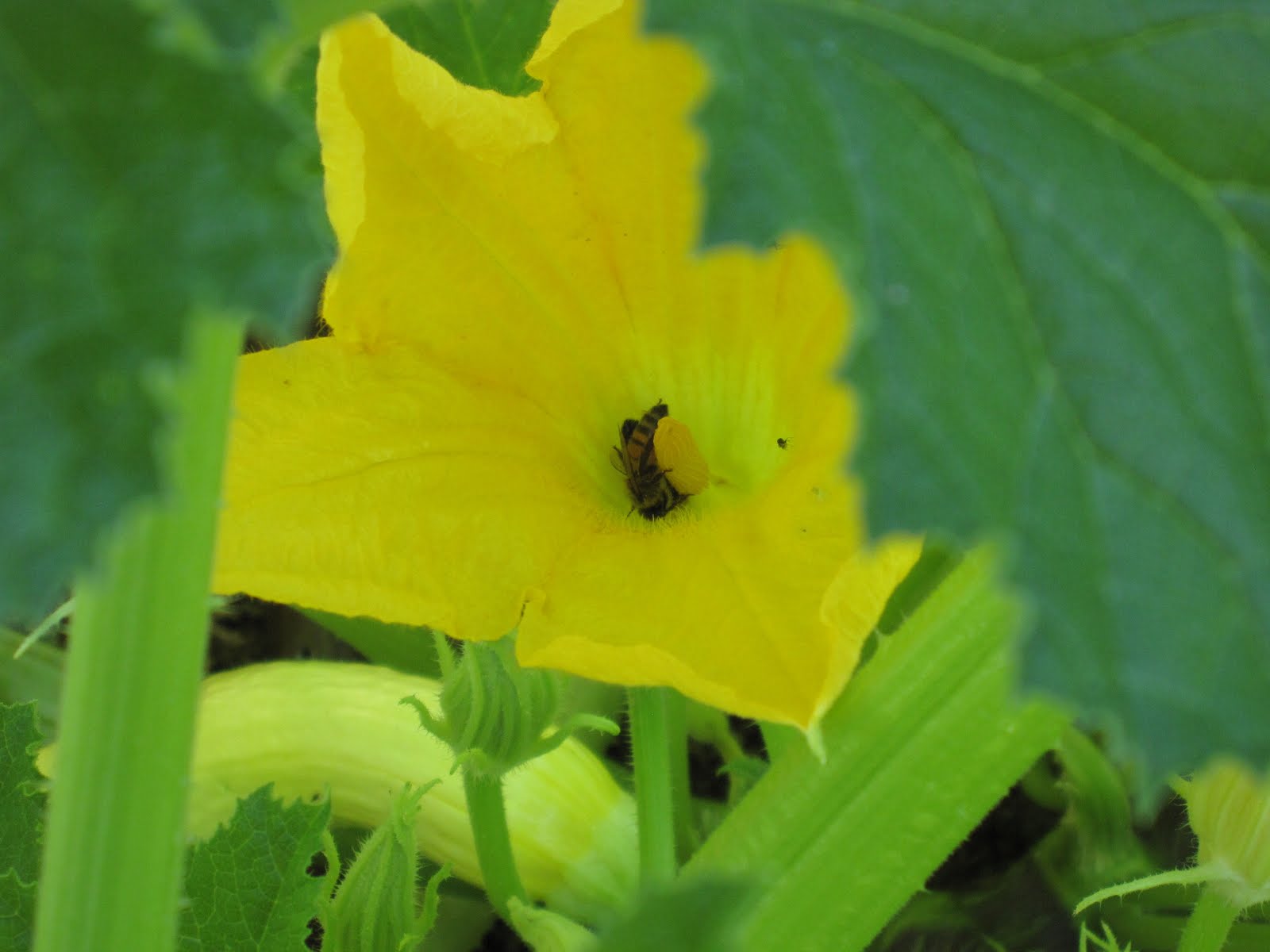
Two bees and a couple of other quite tiny insects vying for position in a squash blossom.


A now deceased grasshopper posing on the stem of a Roger's Red grape I've yet to decide where to plant. While the texture of the grasshopper's shell mimics a leaf, it is hard to disguise oneself when the leaf color changes from green to bright red... gotcha!


An elaborate mega-commune for wasps. Guess I'm going to need to perform a delicate eviction before I can finish painting my house...


Wasn't enough for them to develop a waspene McMansion right outside my patio door. Now, they've gone and built separate mother-in-law's quarters several feet away!


Lady beetle nymphs(?) on Bladderpod pods. Not sure what they were, but I left them to do their job.


And, guess who? When I crouched down to get a different angle on the blossoms of this Santa Cruz Island Buckwheat, whom do you suppose I found lurking beneath?


Trying to look for all the world like a stem and leaves...


... she even mugged for the camera!


Finally, her possibly elusive lover lying in the Palo Verde tree.


As I haven't used any pesticides in my garden for a couple of decades, it just teems with life of the six-legged variety. (Eight-legged, too!) My theory is, there really are no "bad bugs." There are just some that you would rather find dead than alive! If they eat bugs, I leave them alone. If they eat plants, I'm not so forgiving. For the most part, they just party on, whether I am around or not!